Stock Basics · Lesson 75/89 · Advanced · 8 min read
What Is a Greenshoe Option? How Underwriters Stabilize a Stock Right After Its IPO
In this article
- Why Some IPO Stocks Barely Dip Below Their Offer Price at First
- What a Greenshoe Option Actually Is
- Two Opposite Playbooks, Depending on Which Way the Stock Moves
- A Worked Example
- Why Both the Company and the Underwriter Like This Arrangement
- It Doesn't Last Forever — and It Isn't in Every IPO
- Key Takeaways
- Frequently Asked Questions
Why Some IPO Stocks Barely Dip Below Their Offer Price at First
Watch enough newly listed stocks and you'll notice a pattern: for the first few days or weeks after listing, some of them hold surprisingly close to their offer price, even on days when the broader market is shaky. That's not a coincidence. For a short, contractually defined window, the underwriter running the IPO can actually step into the market as a real buyer propping up the price — a mechanism called the greenshoe option, formally known as the over-allotment option. Where IPO lock-up periods covered how insider shares create downward pressure months after listing, the greenshoe option does the opposite in the opposite direction: it supports the price in the days right after an IPO. Both mechanisms revolve around the same event — an IPO — but pull the price in opposite directions at opposite points in time.
What a Greenshoe Option Actually Is
The name is a good place to start. "Green Shoe" has nothing to do with color or footwear function — it comes from the Green Shoe Manufacturing Company (now Stride Rite), a shoe maker founded in 1919 that was the first company to include this clause in its 1963 IPO underwriting agreement. The company's name simply stuck as shorthand for the provision. Its formal name is the over-allotment option.
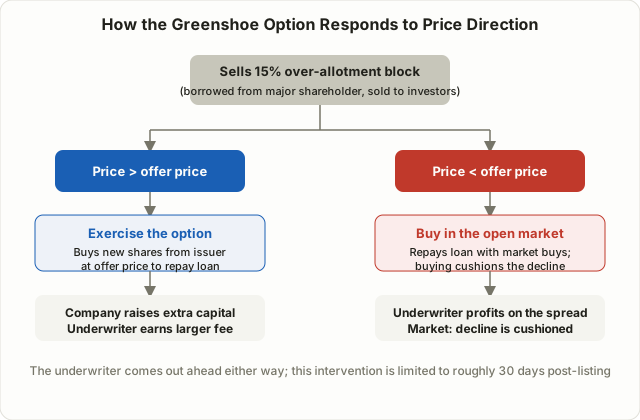
The mechanics work like this. Say a company plans to sell 10 million shares in its IPO. The underwriter negotiates the right to sell up to 15% more — 1.5 million additional shares — on top of that base offering. The catch is that those extra 1.5 million shares haven't actually been issued yet. So if investor demand during book-building is strong enough, the underwriter allocates and sells this extra block to investors anyway, which effectively puts the underwriter in a short position — it has sold shares it doesn't yet own. In practice, the underwriter typically borrows this over-allotment block from a major existing shareholder (in Korea, this is standard practice) before the shares list, so it has real shares to deliver to buyers on day one, but now owes those shares back to the lender.
Two Opposite Playbooks, Depending on Which Way the Stock Moves
The entire point of the greenshoe option is that the underwriter gets to choose how to close out that short position, and the choice depends on where the stock trades relative to the offer price.
If the stock trades above the offer price after listing, buying shares back in the open market to repay the loan would mean buying at a loss. Instead, the underwriter exercises the greenshoe option: it buys the extra 1.5 million shares directly from the issuing company at the original offer price and uses them to repay the borrowed block. The company ends up raising more capital than originally planned, and the underwriter earns a larger fee on the bigger deal. No market intervention is needed in this scenario.
If the stock trades below the offer price, the underwriter does the opposite: it declines to exercise the option and instead buys shares in the open market to repay the loan. Because the market price is now lower than the offer price it originally sold at, the underwriter pockets the difference — and, just as importantly, that buying activity itself absorbs supply and slows the decline. This is what's known as price stabilization, and it's the reason the greenshoe option is often described as a built-in stabilization tool.
A Worked Example
Say hypothetical Company F prices its IPO at ₩10,000 per share and sells 10 million shares. The greenshoe option covers 15%, or 1.5 million shares, which the underwriter borrows from a major shareholder and sells to investors at the offer price alongside the base offering.
| Price rises to ₩12,000 | Price falls to ₩9,000 | |
|---|---|---|
| Underwriter's move | Exercise the greenshoe option | Buy in the open market |
| How the position is closed | Buys 1.5M new shares from the issuer at ₩10,000 (offer price) | Buys 1.5M shares at ₩9,000 in the market |
| Outcome | Repays the borrowed shares with newly issued stock; company raises an extra ₩15 billion | Repays the borrowed shares with market purchases; buying pressure cushions the decline |
| Underwriter's economics | Larger underwriting fee on the bigger deal | Profit of ₩1,000/share (₩10,000 offer − ₩9,000 buy) × 1.5M shares = ₩1.5 billion |
Notice that the underwriter comes out ahead in either scenario — and its profit actually grows the further the price falls, since it's buying back cheaper stock than it sold. In exchange, though, it has to show up as a real buyer during a decline, which is exactly why investors in the aftermarket often see unusually solid buying support near the offer price. That support isn't unlimited, though: the underwriter only has 1.5 million borrowed shares to work with in this example, so selling pressure beyond that size can overwhelm the stabilization effort.
Why Both the Company and the Underwriter Like This Arrangement
The greenshoe option became standard practice because it aligns incentives well. The issuing company only raises the extra capital in the good scenario — when demand is strong enough to push the price above the offer price — so it avoids the risk of having sold too many shares into a weak market. In effect, it lets the deal size flex by up to 15% after the fact, based on how the market actually responds. The underwriter benefits either way: a bigger fee if it exercises the option, or a trading profit if it stabilizes the price instead. Because this arrangement could, in theory, be misused to artificially prop up a stock beyond what genuine stabilization requires, regulators cap it tightly. In the U.S., SEC Rule 104 is the only sanctioned method for post-IPO price stabilization, and it limits the price at which the underwriter can buy (no higher than the lower of the offer price or the best independent bid) as well as the time window for doing so. Korean regulations similarly confine this activity to the window and share limit disclosed in the offering prospectus.
It Doesn't Last Forever — and It Isn't in Every IPO
This intervention isn't open-ended. In the U.S., underwriters typically have roughly 30 days after listing to exercise the option, and stabilization buying under SEC Rule 104 must wrap up within that same window. Korean IPOs operate on a similarly short window specified in the offering documents. Once that period ends, the underwriter's legal basis for intervening disappears, and the stock trades purely on ordinary supply, demand, and fundamentals from then on.
That timing connects directly back to IPO lock-up periods and overhang. In a newly listed stock's early life, a supportive force (the greenshoe option) operates for roughly the first month, while a potentially depressive force (lock-up expiration) looms months later. Much of a new listing's early price action is shaped by these structural, non-fundamental mechanics rather than by the business itself — and only once both windows have passed does the stock's price really start reflecting the market's read on the company alone. Worth flagging: not every IPO includes a greenshoe option in the first place — smaller offerings, or ones where underwriters don't expect heavy oversubscription, sometimes skip it. Whether a given IPO has one, and its exact size, is disclosed in the prospectus under the underwriting section.
One important caveat: a greenshoe option is not a guarantee the stock won't fall below its offer price. The underwriter can only defend the price with the shares it borrowed, capped at 15% of the deal. If selling pressure or negative sentiment about the company overwhelms that limit, the stabilization effort simply runs out of ammunition. It's a short-term volatility cushion, not a mechanism that can override the market's actual read on a company's value.
Key Takeaways
- A greenshoe option lets an IPO underwriter sell up to 15% more shares than the base offering, a practice named after the 1963 IPO of the Green Shoe Manufacturing Company.
- The underwriter typically borrows this extra block from a major shareholder before listing and sells it to investors, effectively taking on a short position it must later close out.
- If the price rises above the offer price, the underwriter exercises the option, buying new shares from the issuer at the offer price; if the price falls below it, the underwriter buys in the open market instead, which cushions the decline — a process called price stabilization.
- This intervention is tightly time-boxed — roughly 30 days post-listing in both the U.S. and Korea — after which the stock trades purely on market forces.
- It's a volatility cushion, not a guarantee: the underwriter can only defend the price up to the size of the borrowed block, and it doesn't override the market's underlying view of the company.
Frequently Asked Questions
If a stock has a greenshoe option, does that mean it can never fall below its offer price?
No. The underwriter can only support the price with the shares it borrowed — capped at 15% of the deal size. If selling pressure or negative sentiment exceeds that, the stock can still trade below the offer price. The greenshoe option cushions volatility; it doesn't guarantee a price floor.
How do I find out if a stock I'm considering has a greenshoe option?
It's disclosed in the prospectus and offering documents filed at the time of listing, under the underwriting section, along with the exact size of the option (up to 15% of the base offering). Not every IPO includes one, so it's worth checking per stock rather than assuming.
Is a greenshoe option the same thing as a lock-up period?
No — they're separate mechanisms that pull in opposite directions. A greenshoe option supports the price for a short window right after listing through underwriter buying. A lock-up period restricts insiders from selling for months after listing, and its expiration can add selling pressure later on. It's worth keeping both timelines in mind when evaluating a recent IPO.
⚠️ This article is for informational purposes only and is not investment advice. Investment decisions and their outcomes are the sole responsibility of the investor.