Stock Basics · Lesson 73/89 · Advanced · 8 min read
IPO Lock-Up Periods Explained: Why Stocks Wobble on Expiration and What 'Overhang' Means
In this article
- Why a Stock That Popped on Day One Can Suddenly Wobble Months Later
- What a Lock-Up Period Actually Is
- Why Prices Move at Expiration: Overhang
- A Worked Example: How Much Does the Float Actually Grow?
- Overhang Isn't Only About Lock-Up Expirations
- What to Check When a Lock-Up Expiration Is Coming
- Key Takeaways
- Frequently Asked Questions
Why a Stock That Popped on Day One Can Suddenly Wobble Months Later
You've probably seen the pattern: a newly listed stock pops well above its offer price on its first trading day, then months later a headline reads something like "shares slide as lock-up expiration nears." The company's earnings or outlook hasn't necessarily changed. What changed is usually not the business — it's who is suddenly allowed to sell, which is a supply-and-demand question, not a fundamentals question. Where Rights Offerings vs. Bonus Issues covered how newly issued shares dilute existing holders, this lesson covers a different mechanism: shares that already exist simply flip from "cannot be sold" to "can be sold," and that flip is enough to move a stock on its own.
What a Lock-Up Period Actually Is
A lock-up period is a contractual (and, in many markets, regulatory) restriction that prevents pre-IPO shareholders — founders, executives, venture capital and private equity investors, and sometimes participating institutional investors — from selling their shares for a set period after the company goes public. The logic is straightforward. Right after an IPO, the market hasn't yet had time to properly test the company's valuation. If insiders could dump shares on day one, ordinary investors who bought into the offering would effectively be buying from people who know the business best and have just decided it's a good time to sell. A lock-up forces those insiders to stay exposed to the stock for a while, which both reduces that information gap and keeps management financially tied to the company's post-IPO performance.
Exact lock-up length and coverage vary by market, exchange rule, and individual deal terms. In the U.S., 90 to 180 days (commonly around six months) is the standard range set by underwriters in the IPO agreement. In Korea, exchange listing rules typically require controlling shareholders and related parties to hold their shares for six months after listing, with the same requirement often extended to anyone who acquired shares from the controlling shareholder, or received shares via a private placement, within the year before the listing application. On top of that baseline, underwriters frequently negotiate additional voluntary lock-ups — three months, six months, or a year — with institutional investors in exchange for larger allocations during book-building. These rules are periodically revised by exchanges (Korea's exchange has, in fact, been discussing lengthening the mandatory holding period for controlling shareholders), so the precise terms for any given stock are best confirmed directly from its prospectus or regulatory filings rather than assumed from general rules of thumb.
Why Prices Move at Expiration: Overhang
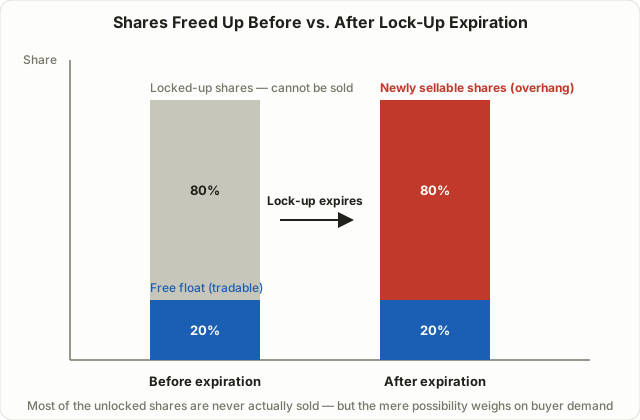
What actually happens on the expiration date comes down to supply and demand. While a lock-up is in effect, the locked shares are effectively excluded from the stock's tradable float — the market behaves as if they don't exist. The moment the lock-up expires, that entire block becomes sellable at once, at least in theory. Market participants call this potential wave of supply an overhang. The key thing about overhang is that it doesn't require any shares to actually be sold to affect the price — the mere possibility that a large block could hit the market at any time is enough to weigh on buyer demand. Traders who know a lock-up is about to expire often hold off on buying, or start trimming positions preemptively, which is why the price impact frequently shows up days or even weeks before the formal expiration date rather than exactly on it.
How much of that unlocked stock actually gets sold depends heavily on who's holding it. Founders and controlling shareholders who remain responsible for running the company tend to keep most of their stake even after the lock-up lifts. Venture capital and private equity funds are a different story: they typically operate on fixed fund lifecycles and are under pressure to return capital to their own limited partners, so they often sell mechanically as soon as they're legally able to. Employees holding stock options or RSUs frequently sell a portion right after vesting or unlocking simply to cover taxes or raise cash — a recurring source of float growth covered in Stock-Based Compensation Dilution that has nothing to do with how the business is actually performing. In other words, the same dollar amount of unlocked stock can carry very different selling pressure depending on whose hands it's in.
A Worked Example: How Much Does the Float Actually Grow?
Take a hypothetical newly listed Company D with 100 million shares outstanding. Say 20 million shares (20%) were sold to the public in the IPO and are freely tradable, while the remaining 80 million shares (80%) — held by founders, management, and VC investors — are under a six-month lock-up. For those six months, only 20 million shares are actually tradable. If average daily volume runs around 400,000 shares, the stock might look like it trades with reasonably healthy turnover relative to its float. The moment the lock-up expires, the tradable float theoretically jumps from 20 million to 100 million shares — a 5x increase. Even if only 10% of the newly unlocked 80 million shares actually get sold, that's 8 million shares — 20 times the stock's typical daily volume. A potential supply increase of that size hitting the market in a short window is enough on its own to dampen buying interest and widen the gap between bid and ask, creating downward pressure on the price.
The actual average size of the lock-up-expiration effect varies a lot by stock and market conditions, but price declines of a few percent around the expiration date are commonly reported, and the effect tends to scale with how large a share of the total float the locked block represents. That's a tendency, not an iron rule — a company with strong fundamentals and solid demand often absorbs the newly available supply without much of a dip at all.
Overhang Isn't Only About Lock-Up Expirations
Lock-up expiration is the most commonly cited source of overhang, but it isn't the only one. As covered in Convertible Bonds (CB) Explained, shares that could be created if convertible bonds or bonds-with-warrants get converted are a form of overhang, as are newly issued shares from a rights offering once they list, shares creditors receive through a debt-for-equity swap during a restructuring, or shares an acquired company's former shareholders receive in a merger and later look to sell. What all of these share is that they weigh on the stock purely through a share-count and supply mechanism — nothing about the underlying business has to change. That's why it's worth tracking how much of this kind of latent supply sits over a stock, separately from how its earnings are trending.
What to Check When a Lock-Up Expiration Is Coming
Lock-up schedules are public, predictable information. The prospectus and offering documents filed at the time of listing name the locked-up shareholders and the exact expiration date, and regulatory filing systems (like Korea's DART) make this searchable after the fact too. When evaluating an upcoming expiration, it helps to look past the date itself at a few specifics: how large the unlocking block is relative to total shares outstanding and to typical daily trading volume; whether the holders are financial investors under pressure to return capital or a controlling shareholder likely to stay invested; and whether the lock-up releases all at once on a single "cliff" date or in stages over time. A single cliff release tends to produce a sharper short-term shock, while staged releases spread that pressure out. Weighing these factors gives a far more useful read than treating "lock-up expiration" as an automatic sell signal.
Key Takeaways
- A lock-up period restricts pre-IPO shareholders — founders, executives, and early investors — from selling for a set period after listing, reducing information asymmetry and keeping insiders financially tied to post-IPO performance.
- Korean exchange rules typically require controlling shareholders to hold shares for six months after listing, on top of which underwriters often negotiate additional voluntary lock-ups with institutional investors; exact terms should be confirmed from each company's filings.
- Overhang refers to the potential wave of selling that a lock-up expiration creates — the mere possibility of a large block hitting the market can pressure the price even before, or without, any shares actually being sold.
- The same unlocked share count carries different real selling pressure depending on who holds it: long-term controlling shareholders typically sell far less than fund investors under pressure to return capital.
- Overhang extends beyond lock-up expirations — convertible bond conversions, rights offerings, and debt-for-equity swaps are all supply-driven pressures with the same underlying logic.
Frequently Asked Questions
Does a stock always fall when its lock-up expires?
No. Declines tend to be larger when the unlocked block is large relative to typical trading volume and heavily held by financial investors, but a company with solid earnings and strong demand often absorbs the new supply with little or no price impact.
Where can I find a stock's lock-up expiration date?
It's disclosed in the prospectus and offering documents filed at the time of the IPO, and it's searchable afterward through regulatory filing databases such as Korea's DART or equivalent disclosure systems in other markets.
Should I avoid a stock just because it has overhang risk?
Not necessarily. Overhang is a short-term supply pressure, not a signal that the underlying business has deteriorated. It's more useful to weigh the size of the unlocking block, who holds it, and the company's actual earnings trend together, rather than reacting to overhang headlines alone.
⚠️ This article is for informational purposes only and is not investment advice. Investment decisions and their outcomes are the sole responsibility of the investor.