Trading Strategies · Lesson 69/69 · 11 min read
How to Trade FOMC and CPI Releases: Straddle Breakout vs. Fade Strategy
In this article
- Why Scheduled Data Releases Move Markets Like a Light Switch
- Before the Release: Expectations Are Already in the Price
- The First Sixty Seconds: When Liquidity Disappears
- Technique A — Straddle Breakout: Betting on Magnitude, Not Direction
- Technique B — Fade: Betting Against the First Move
- Straddle Breakout vs. Fade: When to Use Which
- A Worked Example: One CPI Print, Two Approaches
- Risk Management: Slippage, Spreads, and What Not to Do
- FAQ
- Summary
Why Scheduled Data Releases Move Markets Like a Light Switch
A few times a month, prices jump within seconds like someone flipped a switch. US CPI and the non-farm payrolls (NFP) report both land at scheduled times, and the FOMC's rate decision drops on a six-week cycle, followed roughly 30 minutes later by Fed Chair Jerome Powell's press conference. Traders treat these moments as their own discipline — "news trading" — for one simple reason: more price movement gets packed into a shorter window than at almost any other time of the trading day.
The mechanics behind this burst of volatility are a different animal from the risk-reward math covered in Lesson 6, Risk-Reward Ratio and Money Management. The real driver is that uncertainty resolves all at once. Right up until the release, the market has been pricing itself around the analyst consensus forecast. When the actual number lands outside that range, every position built on the old consensus has to reprice immediately — and that repricing is what produces the sharp move.
This lesson compares two ways traders approach that short, violent window: the straddle breakout and the fade (reversal) strategy. We'll look at why the window is both dangerous and attractive, and how to manage the risk either way.
Before the Release: Expectations Are Already in the Price
The first concept to internalize is that the market is priced in well before the number ever prints. Prices have already absorbed the consensus estimate. That's why a release that matches consensus exactly often produces almost no movement at all — there's nothing left to reprice. A release that misses consensus by a wide margin, on the other hand, forces exactly that repricing, roughly in proportion to the size of the surprise.
This is where the common confusion comes in: "the data was good, so why did the price drop?" If CPI comes in lower than the prior month (disinflationary, generally seen as good news) but the market had already priced in an even more optimistic number, the release can land as a disappointment relative to that inflated expectation — and the price falls anyway. "Buy the rumor, sell the news" isn't a statistically validated rule, but it keeps showing up in practice precisely because of this pre-pricing dynamic.
The options market gives a rough way to gauge how much is already priced in. The price of a near-dated at-the-money straddle (buying a call and a put at the same strike) approximates what the market calls the expected move — how much movement is implied for that release. This is the exact same math covered in Lesson 38, IV Crush, for single-stock earnings — the difference is scope. Lesson 38 covers an event that shakes one stock; this lesson covers events that shake indexes, bonds, currencies, and commodities all at once.
The First Sixty Seconds: When Liquidity Disappears
Market structure itself changes for the roughly thirty seconds before a release through the first minute or two after it.
- Market makers and algos pull their quotes. In the brief window where nobody is sure which way to reprice, liquidity providers protect themselves by widening spreads dramatically or withdrawing quotes altogether.
- Headline-scanning algorithms fire on the number alone. Ultra-fast systems built to compare the printed figure against consensus fire directional orders before any human has time to read the context. That reflexive first wave is often closer to overreaction than analysis.
- Spreads widen several times over. A spread that's normally a tick or two can blow out to five or ten ticks or more at the moment of release. A market order sent into that window routinely fills at a far worse price than expected — this is the slippage that catches unprepared traders.
- The initial spike often gets reversed. FOMC days are a textbook case: the knee-jerk reaction to the written statement and the reaction thirty minutes later to Powell's press conference frequently point in opposite directions. Money that piled in on the statement's wording alone often gets unwound once the actual tone of the Q&A — hawkish or dovish — becomes clear.
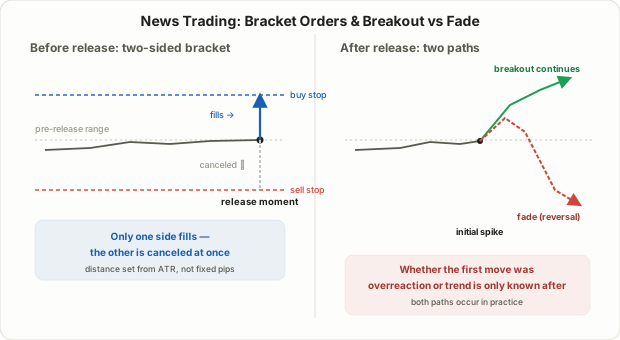
Technique A — Straddle Breakout: Betting on Magnitude, Not Direction
The straddle breakout (sometimes called a "news bracket" among price-action traders, and named for its resemblance to a long options straddle) skips predicting direction entirely. Instead, it places a buy-stop above price and a sell-stop below price just before the release.
- One to two minutes before the release, place a buy stop above the current price and a sell stop below it.
- The distance for each isn't a fixed number of pips or points — it's set relative to recent average true range (ATR) or that specific release's historical expected move, the same volatility-based logic covered in Lesson 13, ATR Stops and Risk Filters. Too tight, and normal release-moment noise triggers both sides (a whipsaw); too wide, and you miss the real directional move entirely.
- The moment one order fills, cancel the other side immediately. Delaying this is the single most common way traders end up eating losses on both sides when the initial spike reverses.
- Attach a stop-loss and target to the filled position automatically, at the same time the bracket is placed. There's rarely enough time to react manually once the spread blows out, so the plan has to be pre-set.
The logic behind this technique is that a genuinely large surprise tends to produce a move that keeps going, at least for a while. Its main appeal is that you don't need to guess direction — its main cost is that having both sides live in a widened-spread environment means ordinary noise can trigger an unwanted fill on either leg.
Technique B — Fade: Betting Against the First Move
The fade strategy takes the opposite view. Instead of jumping on the initial spike, it waits briefly to see whether that first move looks like algorithmic overreaction or the start of a genuine trend, then trades against it.
- Wait for the first post-release candle to close (commonly a 1- to 5-minute bar). Its high and low mark the extremes of the initial spike.
- Watch for the price to start retracing from that extreme — for example, printing a spike high and then sliding back below the level where the spike began.
- Once that retracement is confirmed, enter against the direction of the spike, with a stop placed just outside the spike's extreme (its high or low).
- The target is usually set back at the pre-release range — the assumption being that price reverts toward where it traded before the overreaction.
The case for fading rests on the same headline-scanning overreaction described above: a reflexive order flow triggered by a single number often gets partially unwound once humans digest the underlying detail (for CPI, that means core CPI, shelter costs, and services inflation, not just the headline print). This is a pattern worth watching for, not a rule to apply mechanically — when a surprise is genuinely large and unambiguous, the initial move frequently just keeps running with no reversal at all.
Straddle Breakout vs. Fade: When to Use Which
| Straddle Breakout | Fade (Reversal) | |
|---|---|---|
| Entry timing | Instant, automatic, in the direction of the first spike | After the first candle closes and a retracement is confirmed |
| Order type | Two-sided stop bracket placed before the release | Limit or market entry placed after observing price action |
| Core assumption | The initial reaction develops into a real trend | The initial reaction is overreaction likely to unwind |
| Exposure to the wide-spread window | Fills happen inside that window — high exposure | Entry is delayed until spreads normalize — exposure avoided |
| Loss pattern if wrong | Whipsaw — small losses on both sides in choppy conditions | Stopped out on the far side if the trend just keeps running |
| Best suited for | A large, unambiguous surprise with a clear directional bias | A print close to consensus, or one largely priced in already |
| Reaction speed required | Very fast — automation is essentially mandatory | More forgiving — a minute or more of observation is fine |
The two techniques are mirror images built on opposite assumptions about the same event. The straddle breakout trusts the first move and rides it; the fade distrusts the first move and waits for it to break. Which one has the edge on a given release often comes down to how large surprises on that specific data series tend to run, and whether the broader market has been in a headline-jumpy mood lately — a judgment call traders make release by release, not a fixed rule.
A Worked Example: One CPI Print, Two Approaches
Suppose a hypothetical E-mini Nasdaq future is consolidating tightly around 20,000 right before a CPI release, with a recent 15-minute ATR of 40 points.
Straddle breakout: A buy stop is placed at 20,030 (20,000 + 30 points) and a sell stop at 19,970 (20,000 − 30 points). CPI prints well below consensus (a disinflation surprise), and price spikes immediately to 20,050, filling the buy stop; the sell stop is canceled at once. A stop-loss goes in 25 points below the fill (20,025) and a target 50 points above it (20,100). If price continues higher and reaches the target, this trade nets a 1:2 reward-to-risk ratio on 25 points of risk.
The same moment, fade approach: The first 1-minute candle spikes from 20,000 to 20,060 and closes back down at 20,045. Reading that partial pullback off the 20,060 high as the start of a reversal, a short is entered around 20,045, with a stop just above the spike high at 20,065. The target is set back near the pre-release range around 20,000. If the surprise turns out to be strong enough that price never reverts and just keeps climbing instead, this trade gets stopped out for a 20-point loss — while the straddle breakout trade on the same release comes out ahead.
This example illustrates the core tension: running both techniques on the same release effectively means taking opposite sides of the same bet. In practice, traders either pick one approach per release based on how the specific data point tends to behave, or run each in a fully separate, small, pre-sized account so the two never offset each other's risk budget.
Risk Management: Slippage, Spreads, and What Not to Do
- Avoid new market orders in the minutes immediately around the release. The common rule of thumb is to rely only on pre-placed stop or limit orders during this window rather than reacting with a market order once the spread has already blown out.
- Always use a stop-loss, but budget for slippage. In the seconds when spreads are widest, a stop order can fill several ticks worse than its trigger price rather than exactly at it. Size positions with that gap already factored in, not as an afterthought.
- Cut leverage and position size below your normal level. Volatility itself runs several times higher than usual in this window, so the same nominal stop distance carries more real risk than it would on an ordinary day. Following the account-risk-first sizing principle from Lesson 6 — deciding the dollar risk first and sizing the position to fit it — argues for trading smaller here, not the same size as usual.
- Know the economic calendar cold. The exact release time, the recent surprise history for that specific data series, and the current consensus figure are all known in advance. Getting caught holding an unrelated position through a release window you simply forgot about is a surprisingly common way traders take an unplanned hit.
- Understand your broker's execution policy for news windows. Some retail brokers requote or widen spreads well beyond what's typical during scheduled releases. Check this in advance, before it costs you on a live trade.
FAQ
Which produces bigger moves, FOMC or CPI?
It depends on the specific release and the market regime at the time, so there's no fixed answer. That said, FOMC days tend to spread the volatility across two separate windows — the statement and, roughly 30 minutes later, Powell's press conference — so the total reaction window often runs longer. CPI and NFP, by contrast, tend to concentrate their reaction into a single sharp spike right at release.
Is the straddle breakout the same thing as an options straddle?
The underlying idea is related but the tool is different. An options straddle buys a call and a put together to profit from a large move in either direction. The straddle breakout described here is a price-action technique used in futures, spot, and forex markets — placing a buy stop and sell stop simultaneously rather than buying options. Betting on volatility around single-stock earnings using actual options is covered separately in Lesson 38, IV Crush.
Can retail traders realistically do news trading?
Technically yes, but retail brokers' wider spreads and requoting policies around releases, combined with slower execution than institutional and algorithmic participants, often put retail traders at a real disadvantage from the start. It's worth watching several releases on a demo account first to see the actual slippage your specific platform produces before risking real capital on it.
Summary
- News trading around scheduled economic releases exploits the short, sharp volatility that appears when a surprise relative to consensus forces an instant repricing.
- The first seconds to minutes after a release see spreads widen and liquidity thin out, with headline-scanning algorithms often producing an initial spike that overshoots.
- The straddle breakout places stop orders on both sides before the release and rides whichever direction fills, without needing to predict direction; the fade takes the opposite view, treating that initial move as overreaction and betting on a reversal.
- Both techniques should size their bracket distance and stop-loss off volatility measures like ATR rather than a fixed pip count, which leaves them vulnerable to ordinary noise.
- Avoiding fresh market orders right around the release, trading smaller than usual, and budgeting for slippage in advance are the baseline risk controls for this window.
- Neither technique wins every time — which one has the edge depends on how large and unambiguous the surprise turns out to be, and that can only be judged release by release, not assumed in advance.