Trading Strategies · Lesson 73/73 · 10 min read
Gamma Scalping: Delta-Hedging a Long Straddle to Trade Realized Volatility
In this article
- Betting on "It Will Move a Lot," Not on Which Way
- Why a Long Straddle Is the Starting Point
- The Mechanics: Sell Into Strength, Buy Into Weakness
- A Worked Example: Scalping Profit Has to Beat Theta
- The Rebalancing Dilemma: Too Often vs. Too Rarely
- Gamma Scalping vs. Just Buying and Holding the Straddle
- Who Actually Uses This, and When
- Limitations and Caveats
- FAQ
- Summary
Betting on "It Will Move a Lot," Not on Which Way
Nobody can reliably call whether a stock goes up or down into an earnings report or a big macro event. What's often easier to sense is that it's going to move — a lot — in one direction or the other. Gamma scalping is the technique built around exactly that bet: you don't need to be right about direction, only about magnitude. Options market makers have used it for decades to manage the risk left over from selling options, and it's also the mechanism behind every "long volatility" trade you'll hear options traders discuss. You buy an at-the-money (ATM) straddle — a call and a put at the same strike — and then, every time the underlying price moves, you trade shares (or futures) in the opposite direction to pull the position back to delta-neutral. This lesson breaks down why that repeated rebalancing can be profitable, and why it's harder in practice than the theory suggests.
Why a Long Straddle Is the Starting Point
An ATM call carries a delta near +0.50; an ATM put carries a delta near -0.50. Buy equal quantities of both and the combined position's delta sits close to zero — you start with no directional exposure at all.
The important part is that this neutral state doesn't stay put. Both the call and the put carry positive gamma, so as the underlying rises, the call's delta climbs toward 1 while the put's delta fades toward 0, pushing the combined position's delta positive. When price falls, the same mechanism pushes the position's delta negative. In other words, simply holding the straddle lets the position quietly acquire directional exposure in whichever direction price just moved. Gamma scalping doesn't let that drift sit — it trades the underlying to pull delta back to zero every time it happens.
The Mechanics: Sell Into Strength, Buy Into Weakness
Here's the loop in practice:
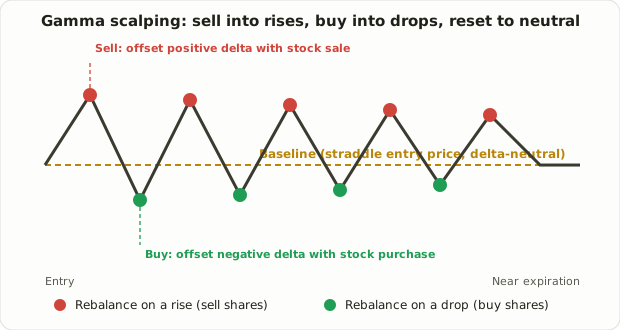
- The stock is at 100 when you buy the ATM straddle. Position delta starts near zero.
- The stock rises to 103. The call's delta rises and the put's delta fades toward zero, so the combined position delta is now, say, +0.30 — equivalent to being long 30 shares.
- To flatten that +0.30, you sell 30 shares. The position returns to delta-neutral, and because you just sold at a higher price than where you started, that trade locks in a small gain on its own.
- If the stock then drops to 97, position delta flips negative (say, -0.35), so you buy shares back to flatten it — this time buying at a lower price.
- Repeat this enough times and you accumulate a stream of "sell high, buy low" trades purely from rebalancing. That stream is the scalping profit.
The key feature: this works regardless of which way price ultimately ends up. The back-and-forth itself is the profit source, so you don't need to call direction — you need the underlying to actually move.
A Worked Example: Scalping Profit Has to Beat Theta
The numbers below are illustrative only — meant to show the mechanism, not a real backtested result. Say the stock sits at 100, and you buy an ATM straddle with a few days left to expiration for a call at 2.0 plus a put at 2.0, for a total cost of 4.0. If that straddle is priced off a 30% annualized implied volatility, standard options math translates that into a "market-implied" daily move of roughly 100 × 0.30 ÷ √252 ≈ 1.9. The straddle also loses value every day purely from theta — assume that decay runs around 0.3–0.4 per day under these conditions.
- A volatile day: the stock swings 100 → 104 → 99 → 103 during the session. Each rebalance back to delta-neutral captures another "sell high, buy low" round trip. If those round trips add up to roughly 0.5 in scalping profit, you net 0.15 after subtracting that day's 0.35 theta cost.
- A quiet day: the same position, but the stock barely moves between 100 and 100.5. Rebalancing captures only about 0.1 in scalping profit, while the 0.35 theta cost comes out in full — a net loss of 0.25 for the day.
What separates those two days isn't direction — it's how much the stock actually moved that day, i.e., realized volatility. Options pricing theory summarizes this with a commonly cited approximation:
Daily gamma P&L ≈ 0.5 × gamma × (underlying price)² × (realized volatility² − implied volatility²) × (1/252)
This formula rests on an idealized assumption of continuous, frictionless hedging — it doesn't account for execution costs or the error introduced by hedging at discrete intervals, so treat it as a theoretical approximation rather than a guaranteed outcome. What it does make clear is the core bet: realized volatility has to exceed the implied volatility you paid for the straddle before accumulated scalping profit can outrun theta decay. If the market turns out quieter than the premium implied, theta wins no matter how diligently you rebalance.
The Rebalancing Dilemma: Too Often vs. Too Rarely
The theory assumes continuous rebalancing; reality forces a choice, and there's a real trade-off on either side.
- Rebalance too often: every tiny delta wobble triggers a trade, and commissions plus the bid-ask spread chew into scalping profit — especially punishing on less liquid underlyings.
- Rebalance too rarely: delta sits away from neutral for longer stretches, so if price reverses sharply in between adjustments, the unhedged exposure that built up can produce a real loss. This is usually called discretization error.
In practice, traders commonly use either a band rule (rebalance whenever delta drifts past, say, ±0.15–0.20) or a time rule (rebalance once or twice a day, at a fixed point like 30 minutes before the close). Neither is a universal standard — both are empirical conventions individual traders tune based on their own cost structure and risk tolerance.
Gamma Scalping vs. Just Buying and Holding the Straddle
The underlying position — a long ATM straddle — is identical either way. What differs entirely is whether you actively rebalance it or simply hold it to expiration, and that difference changes the whole payoff structure.
| Gamma scalping (active rebalancing) | Buy-and-hold straddle (passive) | |
|---|---|---|
| Source of profit | The entire realized price path over the holding period | Only the final price change at expiration |
| Number of trades | Repeated, every time price moves | One entry, one exit (or expiration) |
| Sensitivity to transaction costs | High — repeated trading accumulates commissions and slippage | Low — costs are incurred only at entry and exit |
| Execution requirements | Real-time monitoring; ability to trade (and short) the underlying | Holding the options alone is enough |
| P&L character | Path-dependent — profits even from back-and-forth movement that ends near where it started | Path-independent — needs a large net move by expiration; a round trip back to the strike means a loss |
| Best suited for | A choppy, two-sided volatile market with no clear direction | A single catalyst expected to produce one large directional move |
A buy-and-hold straddle only pays off if price has traveled far enough by expiration. Gamma scalping can profit even from a round trip that ends right back where it started, as long as there was enough movement along the way to harvest. The trade-off is that buy-and-hold is simple and cheap — one trade in, one trade out — while gamma scalping only captures its theoretical edge if you can absorb the complexity and cost of trading the underlying repeatedly.
Who Actually Uses This, and When
Market makers who sell options and delta-hedge the resulting exposure — the same dealers covered in Lesson 15 on gamma exposure (GEX) — sit on the opposite side of this trade. They carry negative gamma and are forced to buy as price rises and sell as it falls. A trader who buys options and actively rebalances instead carries positive gamma and trades the mirror image: selling into rallies, buying into dips.
Retail traders attempting this in practice need to account for a few real constraints:
- A liquid underlying is essential. An index ETF or a large futures contract with tight spreads and fast fills is far more forgiving than a thinly traded single stock, where rebalancing costs alone can exceed the theoretical scalping profit.
- Short-selling access and margin matter. Selling shares into a rally when you don't already own them requires short-selling capability, so account setup and margin rules need to be confirmed in advance.
- Timing relative to implied volatility matters. As covered in Lesson 38 on IV crush, buying a straddle right before an event when implied volatility is already inflated means you're fighting a falling IV (and falling straddle value) on top of trying to scalp gamma. The strategy works best when current implied volatility looks cheap relative to the volatility you actually expect to realize going forward.
Limitations and Caveats
- Continuous hedging is a theoretical ideal. The P&L approximation above assumes instant, frictionless rebalancing. Real execution delays and discrete rebalancing intervals mean the theoretical edge rarely shows up in full.
- Transaction costs disproportionately punish quiet periods. On days with small moves, the scalping profit itself is small, so commissions and spread costs eat a larger share of it — sometimes all of it.
- Gap and jump risk. If realized volatility shows up as a single large overnight gap rather than a smooth accumulation of small moves, there's no opportunity to rebalance in between — the position is simply exposed when the gap happens.
- The core forecast can simply be wrong. The entire strategy rests on a bet that realized volatility will exceed implied volatility. If that forecast is wrong, no amount of careful rebalancing prevents a loss.
- Retail traders face a structural disadvantage versus market makers. Dealers get better fills, lower transaction costs, and faster execution, letting them run the same mechanical process far more cheaply and repeatedly.
FAQ
Is gamma scalping the same thing as gamma exposure (GEX)?
No. Gamma exposure (GEX), covered in Lesson 15, describes how the aggregate positioning of market-wide options dealers affects price — a market-structure concept you observe. Gamma scalping is a technique an individual trader actively executes: buying a long straddle and rebalancing it. Both start from the same Greek, but GEX is something you watch, while gamma scalping is something you do.
Can retail traders realistically gamma scalp?
It's possible but harder than it sounds. Unlike market makers, retail traders face relatively higher transaction costs and can't realistically watch price and rebalance all day. Many retail attempts instead use a simplified version — trading a liquid index ETF or futures contract, rebalancing once or twice a day, or only when delta drifts outside a set range.
How often should you rebalance?
There's no fixed answer. The two most common conventions are a band rule (rebalance whenever delta exceeds a threshold like ±0.15–0.20) and a time rule (rebalance at a fixed point each day, such as 30 minutes before the close). Both are empirical practices traders tune for themselves, balancing transaction costs against hedging error — neither is a rule everyone follows.
Does gamma scalping always make money?
No. If realized volatility ends up lower than the implied volatility priced into the straddle at purchase, the scalping profit from rebalancing won't outrun the theta decay draining the position every day, and the trade ends up a loss. Gamma scalping removes directional risk, but it doesn't remove the risk of being wrong about volatility itself.
Summary
- Gamma scalping starts with a long ATM straddle and repeatedly trades the underlying to pull the position's delta back to neutral every time price moves.
- Rising prices push delta positive (hedged by selling shares); falling prices push delta negative (hedged by buying shares) — the accumulated "sell high, buy low" trades are the scalping profit.
- For that profit to outrun the theta decay draining the position daily, realized volatility has to exceed the implied volatility paid for at entry — that's the core bet.
- Rebalancing too often lets transaction costs eat the edge; rebalancing too rarely increases hedging error — most traders resolve this with an empirical band or time rule rather than a fixed standard.
- Liquidity, transaction costs, and short-selling/margin access put retail traders at a structural disadvantage versus market makers, and a wrong call on realized volatility can turn the strategy into a steady loss no matter how carefully it's executed.