Trading Strategies · Lesson 53/57 · 8 min read
Prop Firm Challenge Trading: Trailing Drawdown vs Daily Loss Limit Rules Explained
In this article
- Prop Firm Rules Are a Different Kind of Risk Management
- How a Typical Evaluation Is Structured
- Three Rules Worth Understanding Cold
- Static vs Trailing Drawdown: Two Completely Different Games
- Why Trailing Drawdown Specifically Punishes Round Trips
- Intraday vs End-of-Day Trailing: A Detail Worth Confirming Before You Trade
- Turning the Rules Into Numbers Before You Trade
- FAQ
- Summary
Prop Firm Rules Are a Different Kind of Risk Management
The Risk/Reward Ratio and Money Management lesson covered how to decide, on your own, how much you're willing to risk per trade. The ATR Stop-Loss and Net-Profit Filters lesson covered adjusting your stop distance to current volatility. Both of those lessons share something in common: you set the rules.
Prop firm ("proprietary trading firm") challenges flip that around. A trader gets a simulated evaluation account — often somewhere between $25,000 and $200,000 — and if they hit a set profit target, the firm allocates real (or firm-backed) capital and splits future profits with the trader, commonly in the 70-90% range. The catch is that the evaluation runs on external constraints the trader doesn't get to choose: a daily loss limit, a maximum drawdown, and often a consistency rule. No matter how sound your strategy is, misunderstanding how these mechanics actually work is exactly how traders get disqualified while their account is still net profitable overall. This lesson focuses on the rule that catches the most people off guard — trailing drawdown — and how it differs from a static drawdown floor.
How a Typical Evaluation Is Structured
Exact terms vary by firm, but a common shape looks like this (treat the numbers below as illustrative conventions frequently cited across firms, not a universal rule):
- Phase 1 (challenge): a profit target often cited in the 8-10% range.
- Phase 2 (verification): a lighter target, often cited around 5%.
- Funded account: after clearing both phases, real or firm-backed capital is allocated — and the firm's drawdown and loss rules typically keep applying.
Single-phase evaluations, and futures-focused prop firms (Topstep, Apex, and similar), have also grown more common. Regardless of the exact structure, three rules show up almost everywhere.
Three Rules Worth Understanding Cold
1. Daily Loss Limit: the maximum you're allowed to lose in a single day, often cited around 5% of starting balance — breach it and the evaluation ends immediately. The critical detail is how it's calculated: some firms compute it off your starting balance (fixed), while others compute it off your highest intraday equity for that day. The equity-based version is far stricter, since it can count an unrealized gain that later evaporates as part of your daily loss.
2. Max Drawdown: the maximum cumulative loss allowed across the entire evaluation, often cited somewhere in the 10-20% range. Whether this ceiling is calculated as static or trailing is the core distinction this lesson is about.
3. Consistency Rule: caps how much of your total profit can come from a single day — often cited somewhere around 30-50% depending on the firm. If your total profit is $4,000 and $2,000 of it came from one day (50%), you could fail this check even with every other rule satisfied. The intent is to filter for a repeatable process rather than one lucky session — though not every firm enforces this rule, so check your specific firm's terms.
Static vs Trailing Drawdown: Two Completely Different Games
| Static Drawdown | Trailing Drawdown | |
|---|---|---|
| Floor is set from | Starting balance, fixed forever (e.g. -10% means always 90% of the starting balance) | Recalculated every time the account hits a new equity high |
| After a new high | Floor stays exactly where it was | Floor rises to track the new high |
| After a pullback | Floor is unchanged | Floor never comes back down once it has risen (a ratchet) |
| Psychological trap | Relatively minor | Your cushion shrinks the moment you're most profitable — a real paradox |
| Commonly seen at | Many forex/CFD prop firms as the base option | Many futures prop firms; some forex firms as an option |
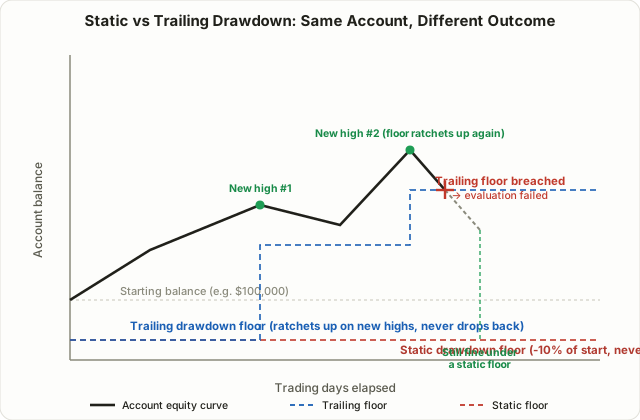
The core difference: a static floor doesn't care how much you've made — it simply never moves. A trailing floor moves up every time your account makes a new high, and once it has moved, it never drops back down. That's exactly why a trader can be net profitable for the entire evaluation and still get disqualified under a trailing rule.
Walking Through the Numbers
Assume a $100,000 starting balance and a 10% max drawdown.
- Good trading pushes the balance up to $115,000 — a new equity high.
- Under a trailing rule, the floor is immediately recalculated: 115,000 × 0.9 = $103,500.
- The market turns, and the balance slides back to $103,000. That's still $3,000 above the original $100,000 starting balance — net profitable for the whole evaluation.
- But it's below the trailing floor of $103,500, so the account is disqualified on the spot.
- Under a static 10% floor (fixed at $90,000 the entire time), that same $103,000 balance would sit $13,000 above the floor — no issue at all.
The lesson here is precise: under a trailing rule, what gets judged isn't the loss itself — it's how much you gave back relative to your peak.
Why Trailing Drawdown Specifically Punishes Round Trips
The core mechanic of a trailing floor is that your buffer resets the instant you make a new high. Right after a new high is exactly when a trader feels most confident — and, under the rules, exactly when the buffer between current equity and the floor is thinnest. Before the new high, there was room between equity and the floor; the moment the new high prints, the floor catches up and that room compresses.
This is the classic trap in practice: after a strong week pushes the account to a new equity peak, a trader often gets more confident, sizes up, or takes more trades than usual — right when the trailing floor has just caught up to current equity. It's a genuine paradox: the moment you're doing best is the moment you should be tightening risk, not loosening it. Miss this mechanic, and a perfectly ordinary pullback — one that wouldn't dent a normal strategy's edge at all — can end the challenge outright.
Intraday vs End-of-Day Trailing: A Detail Worth Confirming Before You Trade
Even among firms that use trailing drawdown, exactly when the floor gets recalculated differs.
- Intraday: the floor tracks your highest equity in real time, including unrealized open-trade gains. Even if you never close the position, a big intraday spike followed by a pullback can move — and then breach — the floor. This is the strictest version.
- End-of-day (EOD): the floor only updates once, based on the balance at the close of each trading day. Intraday swings don't touch it, which gives you more breathing room while a trade is still open.
Two accounts can both be called "trailing drawdown" and require completely different tactics. Under an intraday rule, banking part of a large unrealized gain before it round-trips is often the safer move; under an EOD rule, you have more room to let a trade breathe intraday. Always confirm which version applies by reading the firm's own drawdown documentation.
Turning the Rules Into Numbers Before You Trade
- Convert every percentage rule into a dollar figure on day one. Translating "5% daily loss limit" into an actual number before you place a single trade removes the guesswork mid-session.
- Sizing risk at roughly 0.5-1% of account equity per trade is a commonly cited convention in funded-trader education — not a validated law, but a practical way to make sure a string of normal losing trades doesn't eat the whole daily limit in one session.
- Set a personal daily stop tighter than the firm's. If the firm's daily loss limit is 5%, stopping yourself at roughly 60% of that (3%) leaves room for slippage or multiple open positions hitting stops together.
- On a trailing account, track the distance from equity to the floor every day. Many funded traders trim size or bank partial profits right after a new high, specifically because that's when the give-back risk is largest.
- Track your consistency ratio (best day ÷ total profit) continuously. Traders who follow every other rule sometimes still fail on this one, so a steady equity curve is safer late in an evaluation than one big day.
FAQ
Do the rules disappear once you pass the challenge?
No. Most firms keep applying their own drawdown rules — and often a "scaling plan" that adjusts account size and loss limits as you accumulate profit — after you move to a funded account. Compliance often matters more once real capital is on the line, not less.
Is a static drawdown floor always the better choice?
For give-back risk specifically, static floors are easier to manage. But some firms price static-drawdown accounts with a higher entry fee, or pair them with a smaller max position size or profit split than their trailing option. Which is actually better depends on your trading style (how much intraday volatility you're comfortable holding through) and the full set of terms at your specific firm — not the drawdown mechanic alone.
How do I know if my trailing floor is intraday or end-of-day?
Check the firm's own "Trading Objectives" or "Drawdown Rules" page for the exact wording — "intraday" vs "end-of-day," "balance-based" vs "equity-based." If it's ambiguous, get a written answer from support before risking real evaluation attempts on the assumption.
Summary
Prop firm rules sit as an extra layer on top of the trading strategies covered elsewhere in this course. A strategy with a solid win rate and risk/reward ratio is worthless if it can't survive the daily loss limit, max drawdown, and consistency rule it's actually being evaluated against. Trailing drawdown in particular judges you on how far you've given back from your peak, not on the loss itself — which is exactly why traders used to static floors tend to get caught off guard. Remember the paradox: the moment you hit a new high is the moment to tighten risk management, not relax it. Converting your specific firm's rules into hard numbers before you start trading, rather than trading off a rough mental sense of the terms, is one of the biggest differences between traders who pass and traders who don't.
⚠️ The profit targets, loss limits, and consistency percentages cited in this lesson are illustrative conventions commonly seen across prop firms — not universal or guaranteed rules. Always confirm the current official terms with the specific firm before trading. Also weigh the separate risk that a prop firm itself may fail to honor payouts or shut down — that risk exists independently of how well you trade within its rules.