Trading Strategies · Lesson 94/94 · 9 min read
Social Media Sentiment Trading: Using Mention Velocity to Catch Meme Stock Moves
In this article
- The Number That Sometimes Moves Before the Price
- Why Mentions and Price Feed Into Each Other
- What to Actually Measure (Volume Alone Isn't Enough)
- A Worked Example: Calculating Mention Velocity
- Momentum Chase vs. Sentiment Fade: Same Data, Opposite Trades
- A Practical Checklist Before Acting on a Mention Spike
- Limitations and Traps
- FAQ
- Summary
The Number That Sometimes Moves Before the Price
GameStop's 2021 run and AMC and GME's one-day moves after Keith Gill's ("Roaring Kitty") surprise 2024 return taught a lot of traders the same lesson: by the time the price chart confirmed something was happening, the community had already been screaming about it for hours. Social media sentiment trading starts from that observation. It measures how fast mention volume for a specific ticker is rising on Reddit (r/WallStreetBets), StockTwits, and X — relative to that ticker's own normal baseline — to catch crowd attention building around, or just ahead of, a price move.
This isn't "buy whatever Reddit is yelling about." The goal here is to understand why mention data has any relationship to price at all, what you actually need to measure beyond a raw post count, and — just as important — where this signal breaks down and gets gamed. Every sentiment indicator covered earlier in this course — the Fear & Greed Index (Lesson 87), the put-call ratio (Lesson 60), and the AAII/NAAIM investor surveys (Lesson 88) — is a market-wide composite or a periodic survey. Mention data is different in kind: it's raw, near-real-time attention data you can watch at the single-ticker level, often well before any survey would even ask the question.
Why Mentions and Price Feed Into Each Other
Price moves when new buying money shows up. Traditional analysis assumes that money comes from fundamentals — earnings, guidance, valuation. In low-float, high-retail-ownership names, a different mechanism can take over: attention itself becomes a channel that pulls in buying money.
The loop looks roughly like this:
- Something — a short-interest headline, a celebrity post, a meme — pushes mentions of a ticker noticeably above its normal baseline.
- The spike in mentions gets the ticker surfaced on trending tabs and "most discussed" rankings, putting it in front of more eyeballs.
- Some share of those new eyeballs actually buys, and price moves.
- The price move itself generates a fresh wave of mentions ("why is this up 40%?", "I'm in too"), restarting the loop.
That loop means mentions and price are locked in a two-way relationship, not a clean one-directional "mentions predict price" setup. Academic work analyzing Twitter data has found a real correlation between extreme price swings and spikes in mention volume — but a meaningful share of those spikes followed the price move rather than preceding it. In practice, treat mention volume as fuel that amplifies a move already underway more than as a reliable early-warning radar for a move nobody else has noticed yet.
What to Actually Measure (Volume Alone Isn't Enough)
"Mentions were up 100 posts today" tells you almost nothing on its own. Practitioners generally track four dimensions together.
| Dimension | What it captures | Why it matters |
|---|---|---|
| Volume | Raw mention count over a window | Without a baseline, "100 posts" could be huge or trivial |
| Velocity | Rate of increase, usually a multiple of the recent average | A sharp spike in a short window carries more signal than a slow drift up |
| Tone | Positive/negative/neutral mix | A volume spike built entirely from "why is this crashing" posts reads very differently from hype posts |
| Reach | How far the discussion spreads across influential accounts or separate communities | A dozen reposts from one account is weaker evidence than independent spikes across several communities |
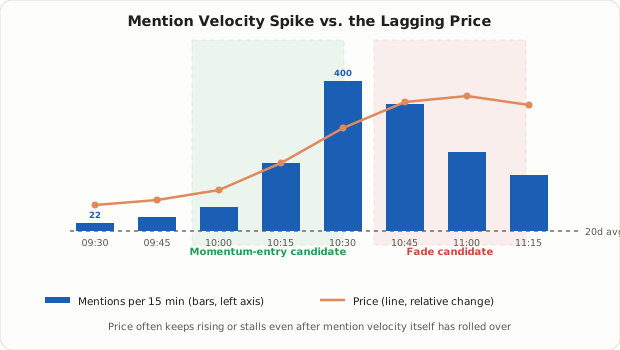
Of the four, velocity is the one practitioners lean on most. Guides covering social sentiment trading as of 2026 generally frame the core variable as how sharply mentions jump relative to a rolling baseline — commonly the trailing 20 trading days at the same time of day. A jump from roughly 20 mentions to 400 within 15 minutes, for instance, is the kind of 20x move that gets flagged as "something unusual is happening right now." These specific multiples aren't an industry-standard, audited threshold, though — they're recurring rules of thumb used across different tools and guides, not a fixed rule you can rely on exactly reproducing elsewhere.
A Worked Example: Calculating Mention Velocity
Here's a hypothetical ticker, "XYZ," to walk through the mechanics. These numbers are illustrative only, not a real case.
| Time | Mentions per 15 min | Trailing 20-day average for that slot | Multiple (velocity) |
|---|---|---|---|
| 09:30 | 22 | 20 | 1.1x |
| 09:45 | 35 | 21 | 1.7x |
| 10:00 | 60 | 22 | 2.7x |
| 10:15 | 180 | 23 | 7.8x |
| 10:30 | 400 | 24 | 16.7x |
| 10:45 | 340 | 24 | 14.2x |
| 11:00 | 210 | 23 | 9.1x |
The jump from 7.8x to 16.7x between 10:15 and 10:30 — more than doubling in one bucket — is the kind of inflection practitioners describe as "velocity accelerating." But notice what happens after: absolute mentions are still running 9-14x above baseline at 10:45-11:00, yet the multiple itself is clearly rolling over (16.7x → 14.2x → 9.1x). Whether you read that rollover as "attention is still elevated" or "the crowd is running out of new buyers" is exactly the fork in the road the next section covers.
Momentum Chase vs. Sentiment Fade: Same Data, Opposite Trades
The same velocity series gets used by traders pursuing opposite strategies. Laying them side by side makes it clearer when each one has a real edge.
| Momentum Chase | Sentiment Fade | |
|---|---|---|
| Core assumption | Early in a velocity spike, most of the new buyers haven't shown up yet | Mentions and price are already stretched, and new buyers are running out |
| Entry timing | During the steep early climb, before the multiple rolls over | After the multiple peaks and starts declining, as price stalls |
| Confirmation needed | Price holding above VWAP, rising options volume alongside the spike | Falling volume, long upper wicks on up-candles, other signs of fading demand |
| Main risk | Chasing a move that's already mostly over — buying the local top | Fading too early, while real demand is still pushing price higher |
| Character | Closer to ultra-short-term momentum trading | Closer to mean reversion / contrarian trading |
In practice, neither side trades mention data alone — both lean on independent price and volume structure to decide which read is more likely correct at that moment. There's no fixed multiple that marks "now chase" or "now fade"; the same 10x reading can mean very different things depending on the stock's normal float and liquidity.
A Practical Checklist Before Acting on a Mention Spike
Mention data on its own is not considered a sufficient trigger. A more disciplined sequence looks like this:
- Confirm the baseline first. Compare against the trailing 20 trading days at the same time of day and day of week — a raw "today vs. yesterday" comparison misses weekday effects and will mislabel ordinary noise as a spike.
- Look for independent evidence in price structure. If mentions are exploding but price is still pinned below VWAP, no buying conviction has actually shown up yet. Holding above a reference level like the anchored VWAP from Lesson 17 is one common first confirmation.
- Cross-check the options market. If the mention spike is accompanied by abnormally high call volume, that lines up with the kind of signal covered in Lesson 22 on unusual options activity, which raises confidence this isn't just talk. Mentions spiking while options flow stays quiet is a sign the "interest" may not be backed by real capital yet.
- Size the position small. This signal's underlying volatility runs extreme in both directions, so applying the risk-reward discipline from Lesson 6 more conservatively than usual is the safer default here.
- Watch for bots and duplicate accounts. A pattern of near-identical phrasing posted repeatedly in a short window is a reason to suspect manufactured buzz rather than organic interest.
Limitations and Traps
- Causality can run backward. As covered above, a mention spike can be the result of a price move rather than its cause. Acting on it can mean chasing a move that's already mostly played out.
- It's exploitable by pump-and-dump actors. There are repeated, documented cases of coordinated groups manufacturing mention spikes specifically to pull in new buyers, then selling into the attention they created. Checking whether a spike's source is concentrated in a handful of accounts versus spread across independent ones is a meaningful filter.
- Bots distort the raw numbers. Automated accounts can inflate mention counts without reflecting any real human interest. Watching volume alone, without also checking reach and tone, leaves you exposed to exactly this kind of distortion.
- The academic evidence is real but mixed and limited. Research combining technical indicators with social sentiment has shown improved stock-trend prediction in some studies, but performance varies significantly by stock. Separately, one university dissertation simulated a strategy selling put spreads around implied-volatility shifts tied to Twitter volume spikes and reported outperforming the S&P 500 over a one-year backtest — but that's a single academic simulation over a specific period and methodology, not a broadly validated, repeatable edge.
- Data quality differs by platform. Reddit, StockTwits, and X have very different user bases and posting formats. A baseline or velocity threshold that works on one platform won't necessarily transfer cleanly to another.
FAQ
Should I buy the moment I see a mention spike?
No. A mention spike signals "something is drawing unusual attention right now," not a buy trigger on its own. The more disciplined approach is to wait for independent confirmation — price holding above a VWAP-style reference level, or a matching signal in options flow — before sizing in, and even then, keeping the position small.
Where can I actually track mention data?
StockTwits provides its own per-ticker message stream and mention-trend data. Professional terminals like Bloomberg run dedicated features that flag abnormal spikes in tweet volume tied to specific tickers. Reddit mentions are typically tracked more indirectly, through subreddit keyword searches or third-party tracking services, since Reddit itself doesn't publish a built-in per-ticker mention feed.
Does this only work on meme stocks?
It shows up most dramatically in low-float, retail-heavy names, where a relatively small amount of new buying can move price a lot. The underlying mechanism can apply to larger names too, but institutional flow and fundamental news dominate price discovery there, so a mention spike alone carries proportionally less weight.
Summary
- Social media sentiment trading tracks mention volume and velocity for individual tickers on Reddit, StockTwits, and X against a rolling baseline, trying to catch crowd attention building around a price move.
- Mentions and price sit in a feedback loop that amplifies in both directions — the evidence does not support treating mention spikes as a clean, one-way leading indicator.
- Volume alone is not enough; tracking velocity, tone, and reach together is what separates manufactured hype from genuine, broad-based interest.
- The same velocity data supports two opposite trades — momentum chasing and sentiment fading — and neither one works reliably without independent price confirmation from tools like VWAP or options flow.
- Pump-and-dump exploitation, bot-inflated counts, and platform-to-platform differences in data quality are real and documented risks, so this signal belongs on the watch list as a supporting radar, sized small and paired with disciplined risk management — never as a standalone trigger.