Trading Strategies · Lesson 22/57 · 9 min read
Unusual Options Activity: How to Read Options Sweeps for Smart-Money Signals
In this article
- Why Large Traders Leave Footprints in the Options Market
- What an Options Sweep Actually Is
- Screening Criteria: Vol/OI, Premium Size, and Fill Location
- A Worked Example: Screening a Sweep by the Numbers
- Why This Signal Can Work: A Market Microstructure View
- Options Flow vs. GEX vs. Order Flow (CVD): What's Different
- Limitations and Pitfalls
- FAQ
- Summary
Why Large Traders Leave Footprints in the Options Market
When an institution or an information-advantaged trader has strong conviction about a stock's direction, they often express that view through options rather than buying shares outright. The same dollar amount buys far more leveraged exposure, and the downside is capped at the premium paid. The catch is that a large options order gets filled in a way that looks noticeably different from ordinary retail flow — and that difference is trackable. Systematically flagging those footprints is what traders call unusual options activity (UOA), and the single strongest pattern within it is the options sweep. This lesson operates at a different layer than Lesson 15's gamma exposure (GEX), which covered the structural pressure options positioning exerts on price. Here, we're reading the informational content of one large order at a time.
What an Options Sweep Actually Is
US options don't trade on a single exchange — they're fragmented across more than a dozen venues, including CBOE, NYSE Arca, ISE, MIAX, and BOX. Because liquidity sitting at the ask differs from venue to venue for the same contract, trying to buy a large quantity on just one exchange quickly moves the price against you as you eat through the visible order book.
A sweep order avoids that problem by splitting the order and routing pieces to multiple exchanges simultaneously, systematically taking out the ask (or bid) at each venue until the full size is filled. The defining feature is speed. A trader placing a sweep is prioritizing getting filled right now over getting the best possible price — which means they're paying the ask to buy (long calls / short puts) or hitting the bid to sell (short calls / long puts) rather than posting a passive limit order and waiting. When you see a large volume of contracts print across several exchanges within seconds — sometimes sub-second — that's the signature of a sweep in the tape.
That urgency is what separates a sweep from an ordinary large trade. A buyer willing to pay up rather than wait for a better price is, by revealed preference, signaling that the cost of delay outweighs the cost of the spread — and many traders read that as a proxy for time-sensitive information or unusually strong conviction.
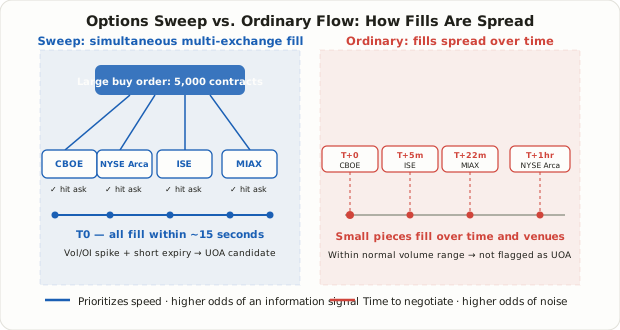
Screening Criteria: Vol/OI, Premium Size, and Fill Location
A large options print isn't automatically "unusual" just because it's big. In practice, traders typically check for several conditions together. The thresholds below are conventions widely cited among options flow data providers and traders — rules of thumb, not fixed standards — and should be scaled to a stock's normal options volume and market cap.
| Screening criterion | Common rule of thumb | What it suggests |
|---|---|---|
| Vol/OI ratio | 3x or higher (day's volume vs. existing open interest) | Fresh position building rather than existing positions being unwound |
| Total premium size | $100,000+ (contracts × premium × 100) | Deliberate capital commitment rather than a random small trade |
| Fill location | At or above the ask | Aggressive taking of liquidity, not passive resting on the bid |
| Time to expiration | Shorter-dated (within a few weeks) skews more directional | Longer-dated contracts are relatively more likely to be hedges or structured positions |
Traders generally only call something "unusual" once several of these line up at once — large size, short-dated, elevated Vol/OI, and a fill near the ask. Any single condition alone produces a lot of false positives. Near-the-money options close to expiration, for instance, are naturally high-volume, so Vol/OI spikes there often have nothing to do with directional information.
Sweep vs. Block: Two Different Flavors of Large Trades
Not every large options print carries the same meaning. Sweeps and block trades both look like "big trades," but their character is quite different.
| Aspect | Options Sweep | Block Trade |
|---|---|---|
| Execution mechanics | Split across multiple exchanges, taking the visible order book | Negotiated privately at an agreed price, filled in one large print |
| Attitude toward speed | Prioritizes immediacy over price | Time to negotiate — no urgency |
| Common motivation | Directional conviction, time-sensitive information | Hedging, institutional rebalancing, structured product setup |
| Typical interpretation | Often treated as a relatively higher-confidence directional signal | Direction is less clear — risk management is a strong alternative explanation |
Block trades, even when large in absolute dollar terms, are frequently hedge-related, which makes them a noisier directional signal than sweeps. A sweep, by contrast, reveals urgency through the mechanics of the fill itself, which is why many traders weight it more heavily as a directional tell.
A Worked Example: Screening a Sweep by the Numbers
Consider a hypothetical setup. A stock has been pulling back toward a support level for several days when, intraday, the tape suddenly shows this fill pattern:
- 5,000 call contracts fill across 4 exchanges within 15 seconds, taken right at the ask
- $2.50 premium per contract, 3 weeks to expiration
- Existing open interest at that strike and expiration is 800 contracts
Total premium here comes to 5,000 contracts × $2.50 × 100 (the contract multiplier) = $1,250,000, and the Vol/OI ratio is 5,000 ÷ 800 = 6.25x — well past the 3x rule of thumb discussed above. Combined with the ask-side fill, the relatively short 3-week expiration, and the simultaneous multi-exchange execution, this pattern would typically be flagged as a textbook "call sweep."
That single data point isn't a reason to buy on its own. It needs to be read alongside chart context — a sweep printing right at a support level is a reasonable case for combining it with the support/resistance logic from Lesson 4 to strengthen an entry thesis. A sweep with no supporting technical context behind it is a much weaker signal in isolation.
Why This Signal Can Work: A Market Microstructure View
The logic behind this technique is rooted in the structure of the options market itself. Options are typically less liquid than the underlying stock, with wider bid-ask spreads. Paying through that spread to accumulate a large position quickly implies a judgment that securing the position now is worth more than the spread cost. A trader without an information edge has little reason to absorb that cost — with no time pressure, waiting for a better limit price is the cheaper play.
In other words, what a sweep reveals is less "how confident is this trader" and more "how much of a hurry are they in." That urgency reportedly shows up more often ahead of events where an information edge decays quickly — earnings, regulatory decisions, M&A rumors. That doesn't mean information-driven bets are always right, though — high-conviction positioning can still be wrong, and a meaningful share of sweeps end up losing money.
Options Flow vs. GEX vs. Order Flow (CVD): What's Different
Three techniques in this course all deal with reading "flow," and it's easy to blur them together. Here's how they differ.
| Technique | What it observes | Question it answers |
|---|---|---|
| Lesson 15: GEX | Aggregate hedging flow dealers owe the market (structural pressure) | Is the current volatility regime dampening or amplifying? |
| Unusual options activity / sweeps (this lesson) | The execution style and aggression of one large order at a time | Did someone just place a large directional bet right now? |
| Lesson 16: Order flow & CVD | Cumulative buy/sell aggression printed in the underlying or futures tape | Who's more aggressive at this price level right now — buyers or sellers? |
All three share the same underlying idea — inferring direction by watching what other participants are actually doing — but they operate at different layers. GEX reads the structural pressure the whole options book creates; sweep analysis reads the informational content of one large order; order flow reads the raw aggression of fills in the underlying itself. In practice, many traders cross-reference all three to build confidence in a read rather than relying on any single one.
Limitations and Pitfalls
- False positives are common. A large share of big options trades are hedges, volatility-selling strategies, or one leg of a delta-neutral structured position — not outright directional bets. Something that looks like a sweep can turn out to be a single leg of a complex multi-leg trade.
- Context matters more than the print itself. Trading off a sweep in isolation, without checking existing trend, support/resistance, or the earnings calendar, produces a lot of noise.
- Real-time data is often paywalled. Services that aggregate cross-exchange fills in real time and automatically flag sweeps typically require a paid subscription; free data is often delayed or aggregated.
- Conviction bets can still be wrong. Even well-informed large traders don't always call it correctly, and "coattailing" a sweep — buying purely because someone else did — risks entering after the informational edge is already priced in.
- The definitions aren't standardized. Thresholds like 3x Vol/OI or $100,000 premium are conventions individual data vendors set, not an industry-wide fixed rule.
FAQ
Is an options sweep the same thing as dark pool trading?
No. Dark pools are venues where large blocks of shares trade privately, off the public order book. Options sweeps happen on public options exchanges, taking out the visible bid or ask across several venues simultaneously. Both aim to track large-trader footprints, but they operate in different markets with different execution mechanics.
Can retail traders track options sweeps in real time?
Access has improved as several options flow scanners now offer real-time sweep and block data at relatively affordable subscription prices. Accuracy and filtering criteria vary meaningfully between providers, though, so it's worth cross-checking any single data source against other signals rather than trusting one feed exclusively.
If I see a lot of call sweeps, does that guarantee the stock goes up?
No. A call-buying sweep can still be part of a call-selling strategy (like unwinding a covered call), a volatility hedge, or simply a directional bet that turns out wrong. Sweep data is best treated as a signal that nudges probabilities, not a standalone reason to buy or sell.
Summary
- An options sweep is a large order that takes out the ask (or bid) across multiple exchanges almost simultaneously, prioritizing speed over price — a pattern widely read as a hint of information advantage or strong conviction.
- Unusual options activity is generally more credible when several conditions overlap at once — a Vol/OI ratio above roughly 3x, sizable total premium, a fill at the ask, and a relatively short time to expiration — and these thresholds are industry conventions, not fixed rules.
- Sweeps prioritize immediacy through aggressive multi-exchange execution, while block trades are pre-negotiated large fills that are relatively more likely to be hedge-related.
- GEX reads the structural pressure of the aggregate options book, order flow/CVD reads the aggression of fills in the underlying, and sweep analysis reads the informational content of individual large orders — three complementary layers rather than competing tools.
- False positives are common and hedges are hard to rule out, so sweep signals are best used to reinforce existing technical analysis rather than as a standalone trading trigger.