Trading Strategies · Lesson 44/57 · 9 min read
Merger Arbitrage (Risk Arbitrage): How to Calculate the Deal Spread and Manage Deal-Break Risk
In this article
- What Merger Arbitrage Actually Is (and Why "Arbitrage" Is Misleading)
- Why the Spread Exists: Time Value and Completion Risk
- Cash Deals vs. Stock-for-Stock Deals: Fundamentally Different Trades
- A Worked Example: Spread and Annualized Return
- Hedging a Stock-for-Stock Deal
- Deal-Break Risk: A Wide Spread Isn't Automatically a Gift
- The 2026 M&A Backdrop and Spread Compression
- How Individual Investors Access This Realistically
- FAQ
- Summary
What Merger Arbitrage Actually Is (and Why "Arbitrage" Is Misleading)
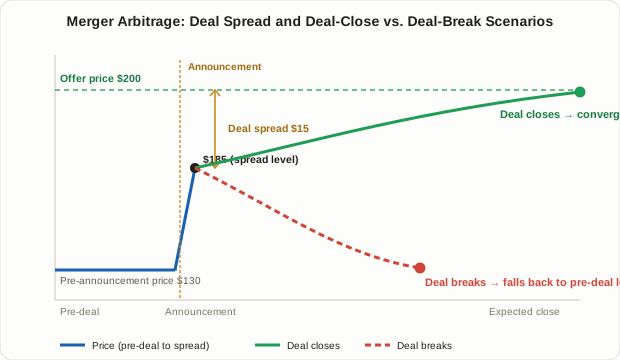
Merger arbitrage, more accurately called risk arbitrage, is an event-driven strategy that enters after an M&A deal has been publicly announced. The logic is straightforward: when Company A announces it will acquire Company B for $200 a share in cash, Company B's stock jumps toward $200 immediately — but not all the way to it. It typically settles somewhere below the offer, say $185 or $190. That gap between the offer price and the trading price is the deal spread, and capturing it is the entire point of the strategy.
The name "arbitrage" implies something close to riskless, which is exactly backwards here — that's precisely why practitioners and academics both prefer "risk arbitrage" as the more honest label. The spread exists in the first place because the market is pricing in a real chance the deal never closes. If it falls apart (a "deal break"), the target's stock typically snaps back toward its pre-announcement level almost overnight, and that single loss can easily wipe out months of accumulated spread gains from other deals. In other words, merger arbitrage has a distinctly asymmetric payoff: small, steady wins most of the time, with the occasional large loss.
Why the Spread Exists: Time Value and Completion Risk
Two forces keep the post-announcement price below the offer price:
- Time value of money. Deals typically take several months to over a year to close. Cash you'd receive ten months from now is worth less than cash in hand today, so the market discounts the price to compensate for that holding period.
- Completion risk. Antitrust regulators could block the deal, the acquirer's financing could fall through, shareholders could vote it down, a rival bidder could show up, or litigation could derail it. The higher the market judges this probability, the wider the spread gets.
This means a wide spread is not automatically a good opportunity — it can just as easily be the market signaling that it thinks the deal is shaky. Conversely, a very tight spread usually means arbitrage capital has already crowded into the trade, or the market is highly confident the deal will close cleanly. Telling these two situations apart is the central skill in this strategy.
Cash Deals vs. Stock-for-Stock Deals: Fundamentally Different Trades
M&A deals split into two broad payment structures, and the arbitrage approach differs completely between them.
| Cash Deal | Stock-for-Stock Deal | |
|---|---|---|
| How the target is paid | Fixed cash amount per share | N shares of the acquirer per target share |
| Spread calculation | Simple (offer price − current price) | Constantly moving with the acquirer's own stock price |
| Position required | Long the target only | Long the target + short the acquirer (hedge) |
| Exposure to price swings | None from the acquirer's stock | Must hedge out acquirer price risk |
| Main risks | Financing failure, regulatory block | Same, plus the acquirer's own fundamental risk |
Cash deals are the simpler version — buy the target and hold until the cash arrives at closing. Stock-for-stock deals require shorting the acquirer's shares in proportion to the exchange ratio to hedge that exposure; otherwise, if the acquirer's stock drops for reasons that have nothing to do with the deal, the arbitrageur loses money on that alone. Plenty of real deals mix cash and stock consideration, in which case each portion needs to be sized and hedged separately.
A Worked Example: Spread and Annualized Return
Take a simple cash-deal example. Company B traded at $130 before the announcement. On January 1, Company A announces an all-cash offer of $200 per share, and B closes the day at $185. The deal is expected to close on November 1 — ten months out.
- Deal spread = offer ($200) − current price ($185) = $15
- Spread return = $15 ÷ $185 ≈ 8.1%
- Annualized return ≈ 8.1% × (12 months ÷ 10 months) ≈ 9.7%
Annualizing matters because it lets you compare deals with very different expected timelines on an equal footing. A deal with a smaller raw spread but a much shorter time to close can annualize to a higher return than one with a fatter spread that takes years to resolve. A 4% spread closing in two months annualizes to roughly 24%; a 15% spread that takes two years annualizes to only about 7.5%.
⚠️ That annualized number is a "success-case" calculation — it only holds if the deal actually closes on schedule. It says nothing about the probability of a deal break. In practice, this expected return needs to be weighed against the probability of failure and the size of the loss if it happens, i.e., viewed through an expected-value lens rather than taken at face value.
Hedging a Stock-for-Stock Deal
Now a stock-deal example. Company C offers to acquire Company D at an exchange ratio of 0.5 shares of C for every share of D. C trades at $80 at announcement.
- Implied deal value = C's price ($80) × exchange ratio (0.5) = $40 per D share
- If D trades at $37 right after the announcement, the spread is $40 − $37 = $3 (about 8.1%)
- Capturing that spread cleanly requires going long 1 share of D and short 0.5 shares of C at the same time.
The hedge matters because holding D unhedged exposes you to C's stock price for reasons that have nothing to do with the merger — if C drops on weak earnings, the value D's shareholders are set to receive falls too. With the hedge in place, a move in C's price shows up as an offsetting gain or loss on the short leg, leaving only the deal spread as the net exposure. This is why merger arbitrage is classified as a market-neutral strategy — like the pairs trading and statistical arbitrage approach covered in Lesson 18, the return comes from the relationship between two securities rather than the market's overall direction.
Deal-Break Risk: A Wide Spread Isn't Automatically a Gift
Spread width reflects both time to close and the market's estimate of failure risk. When you come across an unusually wide spread, work through why before assuming it's an opportunity.
| Check | What to look at |
|---|---|
| Regulatory risk | How long antitrust review is expected to take, and whether similar deals in the sector have recently been blocked |
| Financing certainty | Whether the acquirer's financing is already committed, or the deal carries a financing contingency |
| Shareholder approval | Whether both sides' shareholder votes look secure, or a large holder has signaled opposition |
| Go-shop period | Whether the target can still solicit rival bids during a defined window |
| Termination fee | How large a breakup fee either side owes if the deal collapses — a proxy for how committed both parties are |
| Litigation / activist involvement | Whether shareholders or activist funds are suing over an allegedly low offer price |
If any of these carries real uncertainty, a headline-grabbing spread may still have a poor expected value. Conversely, a deal that has already cleared regulatory approval and locked in financing, with only closing paperwork left, can be a relatively safe trade even at a narrow spread. Spreads that suddenly widen usually do so right after bad news (a negative regulatory signal, a new lawsuit), so treat a widening spread as a prompt to investigate, not a buy signal on its own.
The 2026 M&A Backdrop and Spread Compression
Industry research generally describes 2026 as a period of relatively supportive regulatory conditions, with a steady flow of large announced deals. But a favorable environment carries its own catch: as more deals close reliably and on schedule, more arbitrage capital tends to chase that reliability, and spreads across the strategy tend to compress as competition for the same trades increases. A better environment for deal completion doesn't automatically mean a better environment for arbitrage returns — that's an industry observation repeated across multiple sources, not a hard statistic. Deals still occasionally break late over regulatory objections, and when they do, the target's stock can fall sharply back toward pre-announcement levels — a reminder that deal-break risk is a recurring feature of this strategy, not a theoretical footnote.
How Individual Investors Access This Realistically
Professional arbitrage funds typically spread small positions across dozens of deals simultaneously, so that any single deal break only dents the overall portfolio. Retail investors rarely have the capital or research bandwidth to replicate that diversification one stock at a time, and concentrating in one or two deals means a single break can erase gains from several successful ones.
More realistic approaches for individual investors include:
- Merger arbitrage ETFs that hold dozens of active deals at once, giving structural exposure to the strategy without needing to underwrite each deal individually.
- Small, selective positions in deals with minimal regulatory complexity (friendly acquisitions, non-sensitive industries), kept to a small share of the overall portfolio.
- Sizing around the downside first. As in Lesson 6's Risk/Reward and Money Management, the right order of operations is estimating how far the stock could fall in a deal break before deciding how large a position to take — not sizing off the upside spread alone.
FAQ
Can the deal spread ever go negative?
Rarely, but yes. If the market expects a higher competing bid, or believes the initial offer undervalues the target, the target's stock can trade above the announced offer price. In that case the deal offers no arbitrage return and isn't a candidate for this strategy.
How large is the loss when a deal breaks?
There's no fixed number. Stocks typically fall back toward their pre-announcement level, but the exact drop depends on why the deal failed and broader market conditions at the time. The key asymmetry to remember: accumulated spread gains are usually in the single digits to low teens percentage-wise, while a deal-break drop of 20-40% or more isn't unusual.
Is merger arbitrage market-neutral?
Cash-deal spreads tend to move fairly independently of broad market swings, which gives the strategy a market-neutral character. That said, in severe market stress, financing conditions tend to deteriorate across the board, which can raise deal-break probability across many positions at once — so it isn't entirely insulated from systemic risk.
Summary
- Merger arbitrage (risk arbitrage) captures the deal spread between a target's market price and the announced offer price after M&A is announced; the spread reflects both time value and the market's estimate of completion risk.
- Cash deals only require a long position in the target, while stock-for-stock deals require shorting the acquirer in proportion to the exchange ratio to isolate the pure deal spread.
- Compare deals using annualized returns, but remember that figure assumes the deal closes — weigh it against deal-break probability and loss size to get a real expected value.
- A wide spread signals possible trouble (regulatory, financing, shareholder-vote risk) as often as it signals opportunity, so investigate the cause before treating it as a buy signal.
- Deal-break losses are typically far larger than the spread gains that preceded them, so individual investors are usually better served by diversified merger-arb ETFs or small, low-complexity deal bets sized around the downside case.